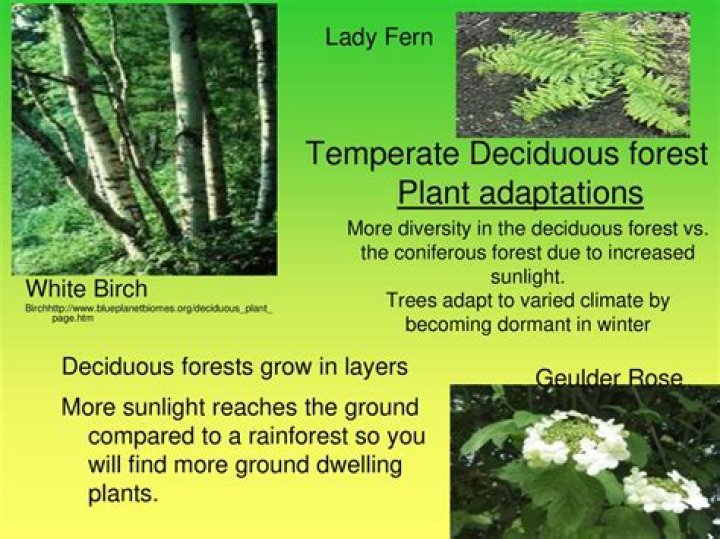
How does the lady fern adapt to their environment?
It will drop its leaves with the first frost. Lady Fern is
relatively tolerant of sun and dry soil, compared to other ferns. The best growth will occur in full to partial shade and a rich, moist soil. This hardy fern also makes a nice ground cover plant on the north or east side of buildings.
How does a fern adapt to the temperate deciduous forest?
The most notable adaptation made by ferns is
the presence of a rhizome. The rhizome, or stem, of the Licorice Fern develops horizontally beneath the soil, containing a growing tip that gives way to new frond development. … Another notable adaptation of fern plants is their pinnately compounded leaves.
Are Lady ferns deciduous?
Lady fern (Athyrium filix-femina). A to Z Botanical Collection/Encyclopædia Britannica, Inc. The
deciduous leaves are about 75 cm (30 inches) long and 25 cm (10 inches) wide and grow in circular clusters.
Do ferns grow in deciduous forest?
It also grows in the wild, especially in
deciduous forests and the taiga of North America and Eurasia. … In the wild, Lady ferns can be found growing in meadows, open thickets, moist woods, and along stream beds.
How do ferns survive?
Ferns live in the
moist habitats because they require water for successful fertilization. After merging of the sperm and egg cells, new fern develops and cycle starts all over again. Fern can also be reproduced from the rhizome and leaves. Ferns are very old organisms.
What are structural adaptations of a fern?
Structural Adaptation
Maidenhair ferns have developed drought tolerance. Usually found in moist shade forests, the fern can acclimate to dry conditions when necessary. The small leaf area minimizes excess evaporation and the rhizome structures underground provide storage in times of deprivation.
What are some plant adaptations in the temperate deciduous forest?
Temperate Deciduous Forest Plant Adaptations
have thin, broad, light-weight leaves that can capture a lot of sunlight to make a lot of food for the tree in warm weather; when the weather gets cooler, the broad leaves cause too much water loss and can be weighed down by too much snow, so the tree drops its leaves.
Why are temperate deciduous forests important?
Deciduous forests are most
important as habitat areas. Many wildlife species rely on deciduous forests and trees as their primary sources of food and shelter. … Deciduous forests are also pleasing to our human senses, especially in the fall when their leaves turn yellow, orange, and red.
How do plant adapt?
Plants
adapt to their environment from necessity. Plants may also adapt by growing lower and closer to the ground to shield themselves from wind and cold. Desert environments may have some of the following adaptations, these help the plant to conserve food, energy and water and still be able to reproduce effectively.
How do plants adapt in the temperate grasslands?
Plants have many adaptations to survive the Grasslands Biome. The
plants have deep, spreading root systems that allow them strength and moisture during times of drought. Most of the plants have long narrow leaves that don’t need as much water. The grasses grow from the bottom and grow close to the ground.
What are five adaptations of plants?
Plant adaptations to life on land include the development of many structures —
a water-repellent cuticle, stomata to regulate water evaporation, specialized cells to provide rigid support against gravity, specialized structures to collect sunlight, alternation of haploid and diploid generations, sexual organs, a …
What are leaf adaptations?
Adaptations of the leaf for
photosynthesis and gaseous exchange. Leaves are adapted for photosynthesis and gaseous exchange. They are adapted for photosynthesis by having a large surface area, and contain openings, called stomata to allow carbon dioxide into the leaf and oxygen out.
How do plants adapt to climate?
Plants adapt to environmental stress by
altering their metabolism, flowering, growth, and reproduction; and by migrating toward areas with more favorable climatic conditions. It is difficult to predict the impact of climate change on individual species, which have different capacities to adapt or migrate.
How do flowers adapt to their environment?
Flowers are an adaptation that
helps many plants make seeds to grow new plants. Some flowering plants use bright petals and sugar water called nectar to get insects to visit. Visiting insects help move pollen among flowers so seeds will form. … Leave them there to make seeds to grow more flowers.)
How do plants adapt to the rainforest?
Drip tips – plants have leaves with pointy tips. This allows water to run off the leaves quickly without damaging or breaking them. Buttress roots – large roots have ridges which create a large surface area that help to support large trees. … They get their nutrients from the air and water, not from the soil.
Do plants have behavioral adaptations?
Behavioural adaptations of plants are
behaviours which give them an advantage. All plant shoots grow quickly towards the light to maximise photosynthesis. … Other plants like the Venus flytrap have evolved structural and behavioural adaptations to catch insects.
How do wildflowers adapt to the deciduous forest?
Wildflowers have adapted to the arid climate at Petrified Forest National Park in many different ways.
Thick, waxy coverings on leaves and stems reduce evaporation. Small leaves reduce the effects of solar radiation and water loss.
How do plants respond to their environment?
Plants respond to their environment.
They grow toward light. Plant leaves bud and seeds germinate when the temperature is right. Their roots and stems grow in certain directions in response to the pull of gravity.
How are plants organs adapted to perform essential functions?
Every plant organ is adapted to its function. For example,
leaves that are big and flat absorb plenty of sunlight for photosynthesis. Long roots keep a tree stable and take water from deep in the soil. … In spring, the potato plant uses the stored starch to grow and make new leaves.