How long does it take dry needling to work?
How Long Does it Take for Dry Needling to Work? In many cases, improved mobility is immediate and decreased pain is felt
within 24 hours. Typically, it may take a few treatment sessions (once a week for 2-3 weeks) for a lasting positive effect.
What does dry needling actually do?
Dry needling
treats muscle tissue, and its goal is to reduce pain, inactivate trigger points and restore function. It rarely is a standalone procedure. Rather, it often is part of a broader physical therapy approach incorporating other traditional physical therapy interventions into treatment.
What happens to the muscle during dry needling?
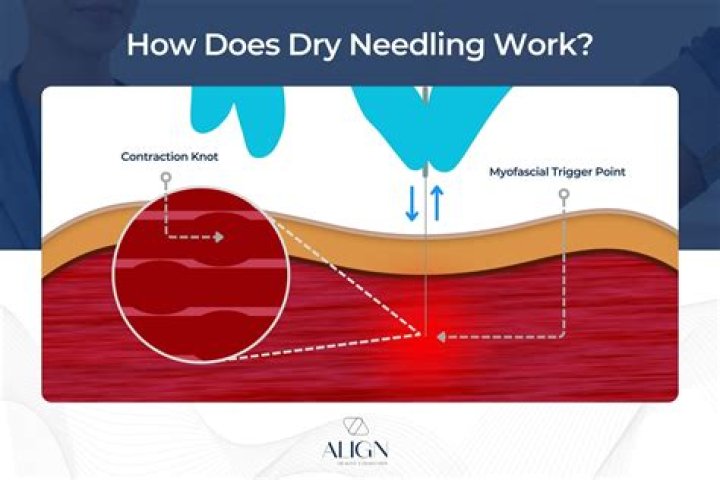
Cyr said dry needling
releases muscle tension, by causing tight muscles to twitch – or cramp – and then relax. “When you get the twitch response,” she said, “science has shown that will change the biochemical makeup of that trigger point to make it much less irritable.”
Why is dry needling so painful?
Does dry needling hurt? The actual inserting of the needle does not hurt—these needles are very thin. Sometimes the muscle will twitch when you put it in, and it can feel sore if that happens. You usually will feel a little muscle ache or soreness for a day or two after that feels like you worked
out that muscle.
How long does dry needling results last?
After dry needling, experiencing some slight soreness is normal, and you will typically note an improvement in your symptoms within
one to two days. How long the benefits will last will vary per individual. The first few treatments will usually have a short length of relief spanning over several days.
What should you not do after dry needling?
What Not to Do after a Dry Needle Treatment- Do Not Use Cold Treatments for the Soreness. It’s common to feel a little sore after a dry needling treatment or have some light bruising. …
- Do Not Overwork Yourself. …
- Do Not Drink Alcohol. …
- Work with a Certified Dry Needling Practitioner. …
- Needle Treatment in Jacksonville.
Can dry needling make things worse?
Some uncommon, sub-1% adverse effects included aggravation of symptoms,
headache, nausea, shaking, itching, and numbness. “Aggravation of symptoms” is one of the most important considerations from the patient perspective (and the least likely to be known/reported by practitioners).
Is dry needling worth it?
What are the benefits of dry needling? Dry needling
may provide relief for some muscular pain and stiffness. In addition, easing the trigger points may improve flexibility and increase range of motion. That’s why this method is often used to treat sports injuries, muscle pain, and even fibromyalgia pain.
Does dry needling get rid of knots?
Dry needle therapy
resolves muscle knots by inserting a very thin needle directly into the trigger point. The knot responds to the interruption and relaxes immediately. Most patients agree that dry needling doesn’t hurt in the way that you might think!
Is dry needling better than massage?
Between-group comparisons showed that
dry needling increased pain threshold significantly more than friction massage. There were no significant differences between groups in any other outcome variables. Dry needling and friction massage were equally effective in improving symptoms in patients with TTH.
How deep do dry needles go?
Trigger point dry needling can be carried out at superficial or deep tissue level. This was developed by Peter Baldry. He recommended the insertion of needles to
5-10mm over a MTrP for 30 secs.
How do you know if dry needling is working?
Dry needling can
reduce muscle tension and improve pain. A twitch can occur when the needle goes into the trigger point, and may be a sign that the therapy is working.
Why is dry needling illegal in some states?
“Dry needling” as it is currently practiced by physical therapists in other states,
poses a hazard to public safety due to inherent risks of under-trained and unregulated practitioners.
What happens when dry needling hits a nerve?
Dry needling, on the other hand, induces both a vascular (blood flow) and
neurogenic (nerve) response that desensitizes the inflamed nerves and regenerates tissue, thereby alleviating pain in the soft tissue and restoring mobility.
How often should you have dry needling?
How many sessions of dry needling will I need? Results’ dry needling patients average 2-3 sessions, and will not use more than 5-6 except in rare circumstances. Often we will use dry needling
once or twice per week out of 2-3 visits.
Why is dry needling controversial?
The distinction between trigger points and acupuncture points for the relief of pain is blurred. The debated distinction between dry needling and acupuncture has become a controversy
because it relates to an issue of scope of practice of various professions.Can I dry needle myself?
Who should not do dry needling?
You should not have dry needling if
you have an infection until after the infection completely resolves. enceinte women, people who are unable to understand the purpose of dry needling, and people who are very afraid of needles should not undergo dry needling.
What is dry needling illegal?
It is
illegal for physical therapists or any other providers to submit claims for payment to Medicare for “dry needling” (a non-covered service) as “physical therapy” (a covered service). Since “dry needling” is acupuncture, it is not a covered service.
Why is dry needling illegal in California?
While some states allow Physical Therapists to perform Dry Needling, the medical board in California concluded that Dry Needling is,
in fact, acupuncture. Therefore, Dry Needling can only be performed by Licensed Acupuncturists and MDs in California.
Does dry needling strengthen muscles?
The results of this case report suggest that dry needling
contributed to improvement in muscle thickness and strength in a subject with muscle dysfunction following an injury.
What is wet needling?
What is Trigger Point Injection Therapy, Acupoint Therapy and “Wet Needling” Trigger point injections or Acupoint Injection therapy employs the
use of hypodermic needles to supply a local anesthetic or homeopathic solution directly into stubborn trigger points for tension release and pain reduction.
Is dry needling FDA approved?
Dry needling is being studied to treat a variety of indications, including myofascial pain, headache or migraine, back pain and painful shoulder conditions. Dry needling is
a procedure and therefore not regulated by the FDA.
Can chiropractors do dry needling?
Chiropractic physicians with
additional post-graduate training in acupuncture are well qualified to perform dry needling techniques.