Examples of carbohydrates in biology
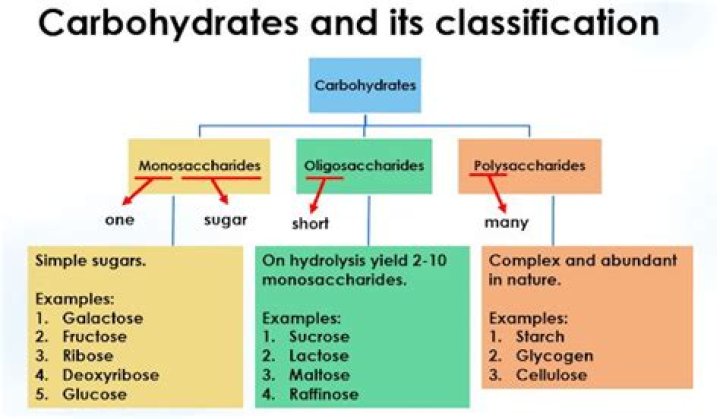
What are three examples of carbohydrates?
What are carbohydrates? Carbohydrates are found in a wide array of both healthy and unhealthy foods—bread, beans, milk, popcorn, potatoes, cookies, spaghetti, soft drinks, corn, and cherry pie. They also come in a variety of forms. The most common and abundant forms are sugars, fibers, and starches.What are carbohydrates examples?
Carbohydrates are thought to be the most abundant organic substances in nature. They can be broadly divided into two main groups; simple carbohydrates (or sugars) and complex carbohydrates (AKA starches). Common examples of simple carbohydrates include glucose, fructose, galactose, sucrose, lactose, and maltose.What are the 3 types of carbohydrates and examples?
There are three main types of carbohydrates:- Sugars. They are also called simple carbohydrates because they are in the most basic form.
- Starches. They are complex carbohydrates, which are made of lots of simple sugars strung together.
- Fiber. It is also a complex carbohydrate.
What are carbohydrates in biology?
Carbohydrates are the most abundant among the major classes of biomolecules. Carbohydrate (biology definition): any of the group of organic compounds consisting of carbon, hydrogen, and oxygen, usually in the ratio of 1:2:1, hence the general formula: Cn (H2O) n. Synonyms: saccharide, carb.What are carbohydrates formula?
The chemical formula of a carbohydrate is Cx(H2O)y, which denotes some carbons (C) with some water molecules (H2O) attached—hence the word carbohydrate, which means “hydrated carbon.”What is carbohydrates in simple words?
Carbohydrates: Mainly sugars and starches, together constituting one of the three principal types of nutrients used as energy sources (calories) by the body. Carbohydrates can also be defined chemically as neutral compounds of carbon, hydrogen and oxygen. The energy produced by carbohydrates is 4 calories per gram.What are the two main carbohydrates?
The two main forms of carbohydrates are sugars (such as fructose, glucose, and lactose) and starches, which are found in foods such as starchy vegetables, grains, rice, breads, and cereals. The body breaks down (or converts) most carbohydrates into the sugar glucose, which is absorbed into the bloodstream.What are sources of simple carbohydrates?
Simple carbohydrates are found naturally in foods such as fruits, milk, and milk products. They are also found in processed and refined sugars such as candy, table sugar, syrups, and soft drinks.What are carbohydrates classify with example?
The simplest carbohydrates are the three carbon dihydroxyacetone and trioses glyceraldehyde. They are further classified into glucose, fructose, galactose, and mannose.1. Monosaccharides:
| Aldoses | Ketoses | |
|---|---|---|
| (C₄H₈O₄) Tetroses | Erythrose | Erythrulose |
| (C₅H₁₀O₅) Pentoses | Ribose | Ribulose |
| (C₆H₁₂O₆) Hexoses | Glucose | Fructose |
What is the difference between carbohydrates starch and glucose?
Monosaccharide contains only one sugar unit, they are the simplest carbohydrates.Complete step by step solution:
| Glucose | Starch |
|---|---|
| Glucose is the simplest form of carbohydrate so it gets easily absorbed by the digestive tract of the organism | Starch is a complex form of glucose it takes time to get absorbed. |
What are biomolecules carbohydrates?
Carbohydrates are biological molecules made of carbon, hydrogen, and oxygen in a ratio of roughly one carbon atom ( Cstart text, C, end text) to one water molecule ( H 2 O text H_2text O H2Ostart text, H, end text, start subscript, 2, end subscript, start text, O, end text).Are simple sugars carbohydrates?
Simple sugars are a type of carbohydrate. Carbohydrates are one of the three basic macronutrients — the other two being protein and fat. Simple sugars are found naturally in fruits and milk, or they can be produced commercially and added to foods to sweeten, prevent spoilage, or improve structure and texture.What are the 6 simple carbohydrates?
These single sugar molecules contain 6 carbon atoms, 12 hydrogen atoms and 6 oxygen atoms (i.e. chemical formula as C6H12O6).Simple Carbohydrates (Sugars)
| Monosaccharides | Disaccharides |
|---|---|
| Glucose | Sucrose (glucose + fructose) |
| Fructose | Lactose (glucose + galactose) |
| Galactose | Maltose (glucose + glucose) |