Characteristics of a good hypothesis
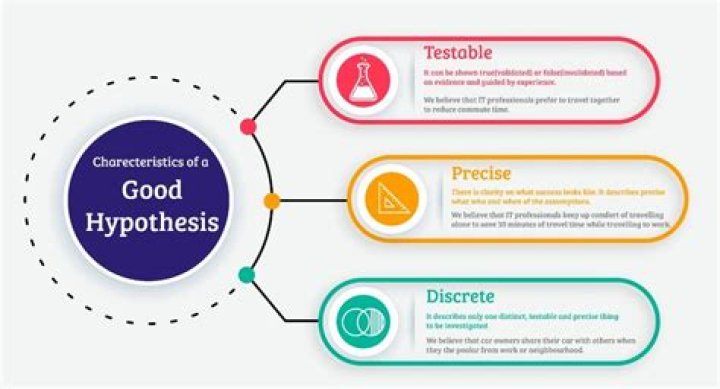
What is the key characteristic of a good hypothesis?
Characteristics of a Good HypothesisFirst, a good hypothesis must be testable and falsifiable. We must be able to test the hypothesis using the methods of science and if you’ll recall Popper’s falsifiability criterion, it must be possible to gather evidence that will disconfirm the hypothesis if it is indeed false.
What are the four characteristics of good hypothesis?
Following are the characteristics of hypothesis: The hypothesis should be clear and precise to consider it to be reliable. If the hypothesis is a relational hypothesis, then it should be stating the relationship between variables. The hypothesis must be specific and should have scope for conducting more tests.What are the two important characteristics of a hypothesis?
The two primary features of a scientific hypothesis are falsifiability and testability, which are reflected in an “If…then” statement summarizing the idea and in the ability to be supported or refuted through observation and experimentation.What should not be a characteristics of a hypothesis?
Answer. Explanation: The characteristic of hypothesis can ‘t be: (b) It should be correct.What is hypothesis and examples?
A hypothesis is an educated guess about something in the world around you. It should be testable, either by experiment or observation. For example: A new medicine you think might work. A way of teaching you think might be better.What are the components of a hypothesis?
The hypothesis test consists of several components; two statements, the null hypothesis and the alternative hypothesis, the test statistic and the critical value, which in turn give us the P-value and the rejection region ( ), respectively.What are the four parts of a hypothesis?
Let’s quickly investigate the four main parts of any hypothesis test:- The Null and Alternative Hypotheses.
- The Test Statistic.
- Probability Values and Statistical Significance.
- The Conclusions of Hypothesis Testing.
What are the 6 parts of a hypothesis?
- SIX STEPS FOR HYPOTHESIS TESTING.
- HYPOTHESES.
- ASSUMPTIONS.
- TEST STATISTIC (or Confidence Interval Structure)
- REJECTION REGION (or Probability Statement)
- CALCULATIONS (Annotated Spreadsheet)
- CONCLUSIONS.
What are the 3 required parts of a hypothesis?
A hypothesis is a prediction you create prior to running an experiment. The common format is: If [cause], then [effect], because [rationale]. In the world of experience optimization, strong hypotheses consist of three distinct parts: a definition of the problem, a proposed solution, and a result.What are the 6 steps to formulate a strong hypothesis?
More videos on YouTube- Ask a Question. In the scientific method, the first step is to ask a question.
- Gather Preliminary Research. It’s time to collect data.
- Formulate an Answer To Your Question.
- Write a Hypothesis.
- Refine Your Hypothesis.
- Create a Null Hypothesis.
What are the three essential elements of a hypothesis?
Key Points of Hypothesis- Does the hypothesis relate an independent and dependent variable? Can you identify the variables?
- Can you test the hypothesis?
- Would your experiment be safe and ethical?
- Is there a simpler or more precise way to state the hypothesis?
How does a hypothesis look like?
A hypothesis often follows a basic format of “If {this happens} then {this will happen}.” One way to structure your hypothesis is to describe what will happen to the dependent variable if you make changes to the independent variable.Is a hypothesis a prediction?
defined as a proposed explanation (and for typically a puzzling observation). A hypothesis is not a prediction. Rather, a prediction is derived from a hypothesis. A causal hypothesis and a law are two different types of scientific knowledge, and a causal hypothesis cannot become a law.What is your hypothesis for this experiment?
The hypothesis is an educated guess as to what will happen during your experiment. The hypothesis is often written using the words “IF” and “THEN.” For example, “If I do not study, then I will fail the test.” The “if’ and “then” statements reflect your independent and dependent variables.How do you explain a hypothesis?
A hypothesis is an assumption, an idea that is proposed for the sake of argument so that it can be tested to see if it might be true. In the scientific method, the hypothesis is constructed before any applicable research has been done, apart from a basic background review.How do you write a hypothesis for an experiment?
However, there are some important things to consider when building a compelling hypothesis.- State the problem that you are trying to solve. Make sure that the hypothesis clearly defines the topic and the focus of the experiment.
- Try to write the hypothesis as an if-then statement.
- Define the variables.
What is the use of formulating a hypothesis?
A hypothesis enables researchers not only to discover a relationship between variables, but also to predict a relationship based on theoretical guidelines and/or empirical evidence. Developing a hypothesis requires a comprehensive understanding of the research topic and an exhaustive review of previous literature.What is the next step after formulating hypothesis?
Step 1: Make observations. Step 2: Formulate a hypothesis. Step 3: Test the hypothesis through experimentation. Step 4: Accept or modify the hypothesis.Why is it important to have a hypothesis?
Importance of Hypothesis:It helps to provide link to the underlying theory and specific research question. It helps in data analysis and measure the validity and reliability of the research. It provides a basis or evidence to prove the validity of the research.